 NO ENTRY Fire & Security
Brighouse··Fire alarm systems
Fire alarm design and installation in West Yorkshire.
We design, install and commission fire alarm systems to BS 5839-1:2025, then keep them serviced. BAFE SP203-1 registered for all four modules. Established in 2012, with offices in Brighouse and Harrogate.
- BAFE register
 Registered for all four modulesID 302600: fire detection and alarm systems
- British Standard5839-1Design, installation and commissioning to the 2025 editionBS 5839-1:2025
- Accredited
 Certificated installerCertificate 12277-P: fire detection and intruder alarms
- Since2012Offices in Brighouse and Harrogate
Who is responsible for your fire alarm?
In a business or other non-domestic building, the legal duty sits with the “responsible person”. That is the employer, owner, landlord, occupier or anyone else in control of the premises.
- Carry out and regularly review a fire risk assessment
- Put suitable fire safety measures in place and keep them maintained
- Record the full fire risk assessment and the fire safety arrangements
These duties come from the Regulatory Reform (Fire Safety) Order 2005. Since 1 October 2023 every responsible person must record the full fire risk assessment and their fire safety arrangements, whatever the size of the business. GOV.UK: fire safety in the workplace.
Which system does your building need?
Every design starts with a site survey of the layout, how the building is used, who is in it and where the risks are. We design for buildings of all sizes, from a small office to a large industrial site or a multi-storey building, with the coverage each one needs and no complexity it doesn’t.
BS 5839-1 sorts systems into categories. The category comes from your fire risk assessment, or is set by the enforcing authority, your insurer or whoever is buying the system. The standard itself does not say which one a building needs.
Simplified plan. It shows only what the table below describes for each category; open it for all eight in one place.
All eight categories, as a table
| Category | What it covers |
|---|---|
| M | Manual call points only |
| L1 | Automatic detection throughout the building |
| L2 | Everything in L3, plus detection in defined higher-risk areas |
| L3 | Escape routes and the rooms that open onto them |
| L4 | Escape routes only |
| L5 | Designed around a specific fire safety objective |
| P1 | Property protection throughout |
| P2 | Property protection in defined areas |
We help you match the category to your fire risk assessment and your insurer’s conditions.
Conventional or addressable?
We install both, and we will tell you which one fits your building and why.
Conventional
- How it reports
- Detectors and call points are grouped into zones. When the alarm activates, the panel shows which zone it came from.
- Suits
- Smaller, straightforward buildings.
Addressable
- How it reports
- Every device has its own programmed location, so the panel shows exactly which detector or call point has activated.
- Suits
- Larger or higher-risk buildings.
Wireless systems Where running cables is difficult, such as in a listed building or for a temporary set-up, a wireless fire alarm system can be the better fit. Ask us whether one suits your building.
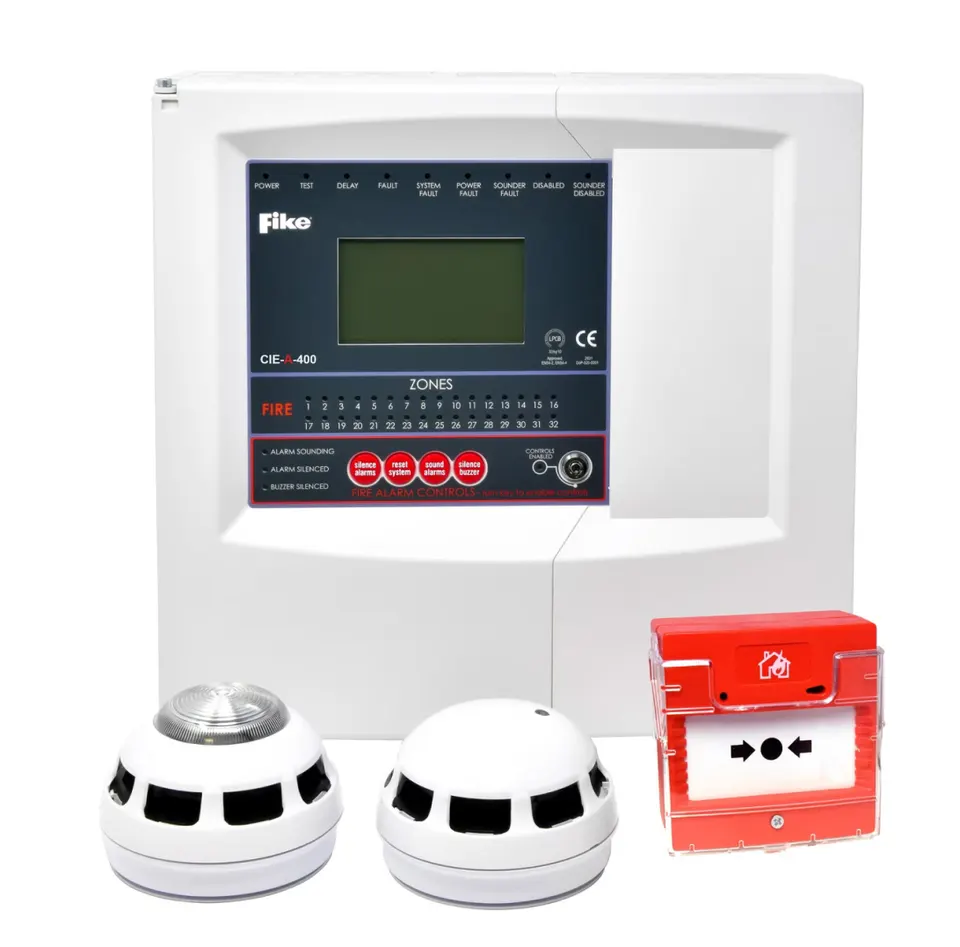
Manufacturers we work with
Panels, detectors and call points
We install fire alarm equipment from established manufacturers, including C-TEC and Fike control panels, with the detectors, call points and sounders your design calls for.


How an installation works
Five stages, from the first survey to commissioning the fire alarm panel and handing it over.
- 01
Survey
We visit the building, look at how it is used and read your fire risk assessment.
- 02
Design
We design the system to the category the building needs and agree it with you.
- 03
Install
We install the system to the agreed design.
- 04
Commission
We commission and test the system before handover.
- 05
Handover
You receive the BAFE Certificate of Compliance for the work, and the system’s records start in the fire logbook.
Accredited for fire
What your BAFE certificate tells you
Work carried out under BAFE SP203-1 comes with a BAFE Certificate of Compliance. It gives you, your fire authority and building control evidence that the work was done competently.
We certify our own work on the system. We do not certify that a building is fire safe, because that sits with the responsible person and the fire risk assessment. You can check our registration, and the modules we hold, on the BAFE Fire Safety Register under ID 302600.
Our credentials
- Rated by customers
- 4.3 from 17 Google reviews
- Our Google rating as of October 2026.
- Founded in Leeds
- 2012 established
- Based in Brighouse since 2015, with a second office in Harrogate.
Testing, servicing and your logbook
After handover, BS 5839-1 expects three things. Each has an owner and a rhythm. They are what the standard recommends, so read them alongside your fire risk assessment.
-
Every week
Weekly test
WhoYou, the responsible person
You, or someone you appoint, test the system every week from a call point, using a different one each week where practical.
Rotate through the call points so each one is tested in turn, and log the result.
-
Every six months at most
Professional servicing
WhoA competent person
A competent person services it at intervals of no more than six months. Some buildings are still serviced once a year, which leaves a gap against the standard.
We offer six-monthly fire alarm servicing, and our fire alarm checklist for businesses covers what to record.
-
Every time something happens
Ongoing records
WhereThe fire logbook, kept near the panel
And everything goes in the fire logbook kept near the panel: test results, service dates, faults, activations, drills and training.
Log false alarms as well as genuine fires, and anything else that affects the system, such as alterations.
West Yorkshire policy
When the alarm goes off, who comes?
Since 18 March 2024, West Yorkshire Fire and Rescue Service has not attended fire alarm signals automatically at non-sleeping commercial premises, such as shops, leisure venues and factories. A 999 call reporting fire or signs of fire is needed. Sleeping premises, schools and colleges, heritage buildings and high-risk chemical sites still get an automatic response. The service also charges for persistent false alarms. WYFRS: automatic fire alarms.
Such as shops, leisure venues and factories
No automatic attendanceSomeone has to call 999 to report fire or signs of fire.
Schools and colleges, heritage buildings and high-risk chemical sites
Automatic responseThese still get an automatic response.
So your on-site procedure matters: who checks, who calls 999, who gets contacted.
We can help fit the alarm into your wider fire procedures, so the people doing drills and training know what the system will do.
You can send alarm signals to a receiving centre that answers them 24 hours a day. In Harrogate, North Yorkshire Fire and Rescue Service sets its own policy, so check theirs rather than relying on the West Yorkshire rules.
Phone line switch-off
31.01.2027Analogue phone lines are due to be switched off by 31 January 2027, and a fire alarm that signals over one will stop signalling. We can check how yours signals today and tell you what it needs before the switch-off. See the phone line switch-off.
Where we work and who we work for
From our offices in Brighouse and Harrogate we install and maintain fire alarms across West Yorkshire and North Yorkshire, and for clients nationwide.
- Offices and shopsFrom a single unit to a multi-storey building.
- Industrial sites and factoriesLarger and higher-risk buildings.
- Homes and rented propertyWe fit fire alarms in homes as well as businesses. Homes and rented property follow a different part of the standard, BS 5839-6, with its own grades and categories, and we can advise which suit yours.
Escape routes often need emergency lighting as well, depending on your fire risk assessment.
Common questions
Something else? Call 0800 107 5345 or ask at your survey.
BS 5839-1 changed in 2025. Does my existing system need upgrading?
BS 5839-1:2025 replaced the 2017 edition on 30 April 2025. Existing systems generally do not have to be upgraded just because the standard changed, unless they are modified or refurbished. It is worth having yours reviewed at its next service.
Do I need a fire logbook?
Yes. BS 5839-1 expects a logbook kept on site near the panel, recording weekly tests, services, faults, activations, drills and training. Keep it where the person doing the weekly test can find it.
Will the fire service come if my alarm goes off?
In West Yorkshire, not automatically at non-sleeping commercial premises such as a shop or factory. Someone needs to call 999 to report a fire.
How can I check you are BAFE registered?
Search the BAFE Fire Safety Register for ID 302600. It shows our scheme (SP203-1, fire detection and alarm systems) and the modules we hold.
Protection doesn’t stop here.
Most buildings need more than one system. One company can install them, keep them serviced and put them right when something goes wrong.
- Servicing and maintenancePlanned servicing for every system we look after
- Fire alarm monitoringFire alarm signals answered day and night
- Emergency lightingEscape lighting designed and installed to BS 5266-1
- Fire alarm faults and repairsFaults, false alarms and repairs
- Why you need a fire alarm systemFrom our news and guides
- Fire and security for businessesOffices, shops, schools and industrial sites
- Our Harrogate officeOur office at 12 Station Parade